
On this page
Size and number
A downspout's job is to drain its share of roof faster than rain fills the gutter. Too few or too small, and the gutter overflows no matter how big it is.
| Downspout | Typical pairing |
|---|---|
| 2x3 inch | 5-inch gutters on small roof areas |
| 3x4 inch | 5-inch on larger areas, or 6-inch gutters |
| 3-inch or 4-inch round | Half-round gutters |
Larger downspouts also clog less with pine needles and oak catkins, which matters under local trees.
Placement
A good installer places outlets so that:
- Each run drains toward an outlet with a steady slope
- Long runs have an outlet at each end or in the middle
- Water lands where the ground slopes away
- Discharge does not cross walkways, driveways or doorways
- Discharge stays away from crawl space vents and window wells
Where the water goes
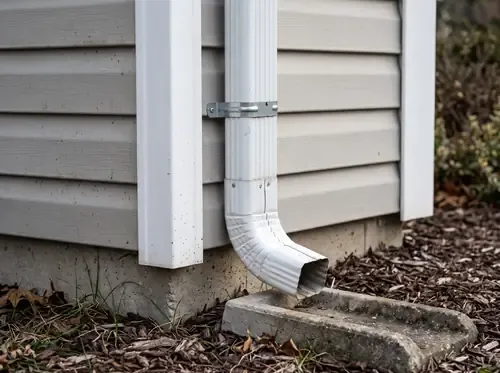
Many homes around Wilmington sit on sandy soils that absorb water well when it is spread out. NC State Extension recommends directing downspouts away from concrete and asphalt and onto vegetated areas, and says that disconnecting impervious surfaces this way can cut runoff volumes in half in southeastern NC's sandy soils. It is also simple: an extension or a splash block onto lawn or a planted bed.
On flat, low lots near creeks or marsh, water may not soak in fast during heavy rain. Then extensions need to carry it farther, or toward a swale or rain garden.
Rain barrels
Rain barrels catch roof water for gardens. In New Hanover County, the Soil and Water Conservation District sells discounted barrels at monthly sales for $85, and eligible residents can get one free, according to the City of Wilmington. A barrel needs an overflow that goes somewhere sensible, because a barrel fills in minutes in a summer storm.
Underground drains
Buried downspout pipes are common on newer homes. They are tidy, but debris that gets past the gutter collects in them. If a downspout backs up at the bottom, the buried line may be blocked. See downspout repair.
Wind
Downspouts should be strapped to the wall at each section and at the elbows. Loose downspouts are among the first parts lost in a storm.
Causes of downspout trouble
Downspouts fail in predictable ways. Elbows clog first, because debris catches where the pipe turns. Straps rust or loosen, and the downspout swings away from the wall. Bottoms get crushed by mowers. Extensions get moved and never put back. Buried pipes fill with sand and debris. See downspout repair.
Crawl spaces and slabs
Many houses in the area are built over crawl spaces, and many newer ones on slabs. On crawl space houses, downspouts should not discharge next to foundation vents or against the block wall, where water can soak through or pond under the house. On slab houses, water dumped onto a patio or driveway may run back to door thresholds. The aim in both cases is the same: put water on ground that slopes away and can absorb it.
Underground drains and sand
Buried downspout drains are tidy, but on sandy lots they often fill with sand washed off the roof and yard. Each buried line should have a clean-out near the downspout and a pop-up emitter or daylight outlet at the far end. If water bubbles out at the base of the downspout in rain, the line is blocked.
Repair vs replace
Downspouts are cheap compared with gutters. Crushed or split sections are replaced rather than repaired. When gutters are replaced, downspouts usually are too, often upsized.
Cost factors
Each downspout adds material, an outlet, elbows, straps and labor. Larger 3x4-inch downspouts cost a little more than 2x3. Buried drain lines add digging and pipe.
Downspout questions
What is the difference between a downspout and a leader?
Nothing. Downspout, leader, conductor and drain pipe all describe the vertical pipe that carries water from the gutter to the ground.
What are A and B elbows?
Elbows bend the downspout. An A elbow turns it toward or away from the wall (front to back); a B elbow turns it sideways along the wall. Installers use them to clear trim, steps and windows.
What is a pop-up emitter?
A cap at the end of a buried downspout pipe that lifts when water pushes through and closes when flow stops, spreading water on the lawn and keeping debris and pests out.
How many downspouts does a gutter run need?
It depends on roof area, pitch and rainfall intensity. Long runs often need an outlet at each end or in the middle, and valley corners need one close by. The contractor should size and place them from the roof, not by habit.
Downspout discharge options
| Option | Best for |
|---|---|
| Splash block | Short discharge onto lawn |
| Rigid extension | Carrying water several feet out |
| Flexible or hinged extension | Areas that need access |
| Buried pipe to pop-up | Tidy lawns, longer distances |
| Rain barrel with overflow | Collecting garden water |
| Rain garden | Absorbing large volumes |
What to ask
- What size downspouts, and why?
- Where does each one discharge?
- How are they strapped to the wall?
- Will you add extensions or splash blocks?