
On this page
Perforated screens
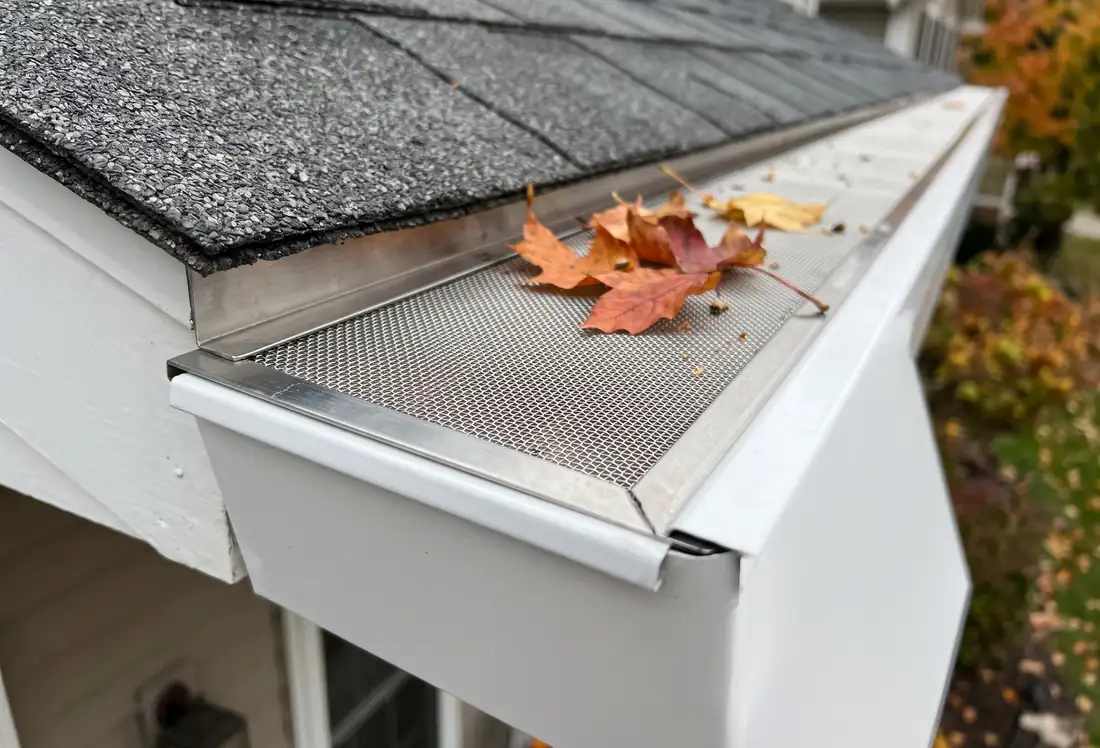
Perforated aluminum screens have punched holes or slots. They keep out leaves, twigs and moss, but small debris and pine needles get through or lodge in the holes. Over time the holes fill and water runs off the top.
Good for: houses with broadleaf trees nearby, budgets that do not stretch to mesh. Weak with: pine needles, oak catkins, seeds.
Reverse-curve guards
A reverse-curve guard covers the gutter with a solid hood. Water clings to the curved front edge and drops into a narrow slot; debris falls to the ground.
Good for: large leaves. Weak with: pine needles, which lie across the slot; heavy rain on steep roofs, where water can overshoot the curve.
Comparison
| Screen | Reverse-curve | Micro-mesh | |
|---|---|---|---|
| Pine needles | Poor | Poor | Good |
| Oak leaves | Fair | Good | Good |
| Heavy rain | Good | Fair | Good |
| Price | Low | High | Medium to high |
| Maintenance | Moderate | Low to moderate | Low |
See micro-mesh gutter guards and the are gutter guards worth it guide.
Local fit
Under the pines common in Leland, Boiling Spring Lakes and Castle Hayne, screens and reverse-curve guards often disappoint. On beach houses with little tree cover, a sturdy screen may be all that is needed against blown sand and occasional debris.
Wind and salt
Snap-in screens should be fastened in place in a storm-prone area, or wind can lift them. Near the ocean, choose aluminum or stainless rather than painted steel. See gutters in salt air. Clearing gutters before storms is part of ReadyNC's hurricane advice, and loose guards make that harder.
Common problems
- Pine needles wedged in screen holes, blocking water
- Screens lifted by wind or sagging between supports
- Reverse-curve slots blocked by needles lying across them
- Water overshooting reverse-curve hoods on steep roofs in heavy rain
- Debris building up behind guards that sit flat
Repair vs replace
Clogged screens can be cleaned or flipped; bent ones replaced. If a house keeps needing screens cleared, replacing them with fine mesh is usually the better long-term choice. Reverse-curve systems that overshoot on a steep roof are hard to fix; often a different guard type is the answer.
Cost factors
Screens are among the cheapest guards. Reverse-curve hoods are often sold as premium systems and cost more. Fit, fastening and gutter repairs beforehand add to either.
When screens are enough
On a single-story house with few trees nearby, a fastened aluminum screen keeps out the occasional leaf, nest and blown debris at low cost. If the main problem is pine straw, budget for mesh instead.
Screen and hood guard questions
What is a gutter hood?
Another name for a reverse-curve or surface-tension guard: a solid cover over the gutter with a rounded front edge that water follows into a slot while debris slides off.
Are snap-in screens any good?
They are inexpensive and keep out large leaves and nests. They are less effective with pine needles and can lift in wind unless fastened.
Can different guards be mixed on one house?
Yes. Some owners use mesh under pines and simpler screens on sections with no trees overhead, which keeps costs down.
Do hoods work in hurricanes?
In very heavy rain, water can overshoot the curve, especially on steep roofs. Hoods are also another surface for wind to catch, so fastening matters.
Choosing a guard by tree type
| Tree overhead | Best guard |
|---|---|
| Pines | Micro-mesh |
| Live oaks | Micro-mesh or fine screen |
| Magnolias | Screen, hood or mesh |
| Few or no trees | Screen, or no guard |
| Mixed woods | Micro-mesh |
What to ask
- Which guard suits the trees around my house?
- How is it fastened against wind?
- What will it not keep out?